
"Nobody—that's my name"?_
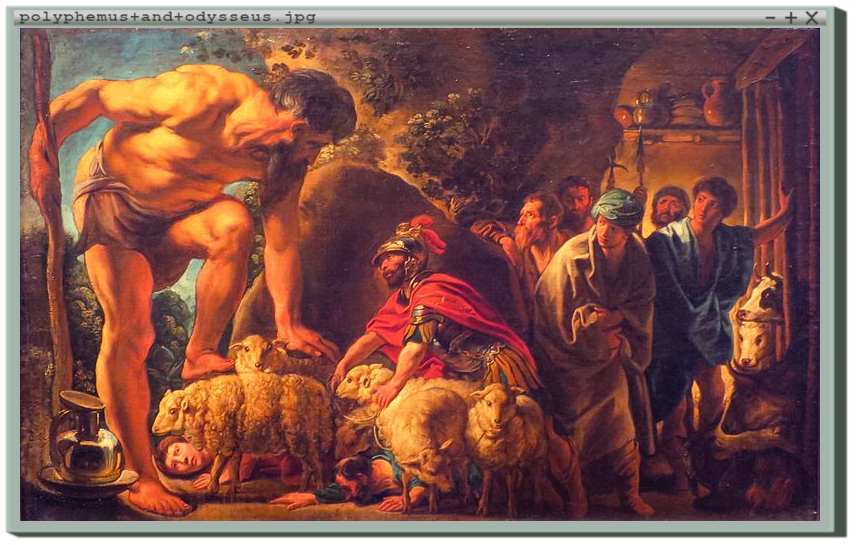
"Odysseus in the Cave of Polyphemus," Jacob Jordaens (1593-1678)
One of the most interesting components of Professor Giannopoulou's lecture was the concept of being civilized and the role it plays in the narrative Odysseus tells. His accounts are unconfirmable, as all his companions have died, and so the Phaeacians, his audience, have only his word that these events happened as he tells them. Odysseus, skilled rhetorician as he is, uses this to his advantage to retroactively justify his actions and to implicitly—subtly—threaten the Phaeacians. He uses the idea of being civilized to paint the Cyclops, Polyphemus, as an uncivilized brute that committed a crime worthy of punishment from Odysseus.
In Book 9 of Odyssey by Homer, Odysseus has lost everything. As Professor Giannopoulou's lecture reveals, Odysseus, having lost his men and his ship, has arrived in the fictional Phaeacia, where he is relying on the Phaeacians to provide him with safe passage home, along with treasures to bring back to Ithaca. But, before Odysseus can embark on his journey home, he must first honor the sacred ritual, Xenia, and exchange gifts with the Phaeacians by telling a story so great it convinces them to grant him an escort home with treasures.
Even as Odysseus narrates his first arrival to the land of Cyclopes, he paints the Cyclopes as uncivilized, declaring that they are, "lawless brutes, who trust so to the everlasting gods / they never plant with their own hands or plow the soil" (9.120-121). He adds that they are so brutish that they lack the intelligence to properly utilize their land—"Unsown, unplowed, the earth teems with all they need, wheat, barley and vines, swelled by the rains of Zeus" (9.122-123)—or foster community between themselves, unlike civilized people who follow common laws which maintain societies—"They have no / meeting place for council, no laws either, / no, up on the mountain peaks they live in arching caverns / each a law to himself, ruling his wives and children" (9.125-127). In introducing the Cyclopes as uncivilized, Odysseus has othered them in his narrative, turning the Cyclops into a monster deserving of his punishment later in the story.
When Odysseus and his men come across the Cyclops' cave, they immediately enter and begin eating the Cyclops' cheeses while planning how they will take his lambs for themselves, only to then ask for a customary guest-gift when they are discovered by the Cyclops, Polyphemus, who demands to know what strangers are doing in his home. Odysseus' request for a guest gift is "the custom," he says (9.302), a reference to Xenia, which, as Professor Giannoupolou's lecture explains, requires hosts to follow a specific set of steps when a stranger arrives at their door. Odysseus' invocation of Xenia is ironic because, Odysseus later uses Polyphemus' supposed violation of Xenia as justification for his blinding, yet Odysseus violated Xenia first by trespassing into the cave without first being invited. Odysseus is also subtly warning the Phaeacians that if they do not abide by the steps of Xenia they will be punished too, showing them the consequences of violating the ritual.
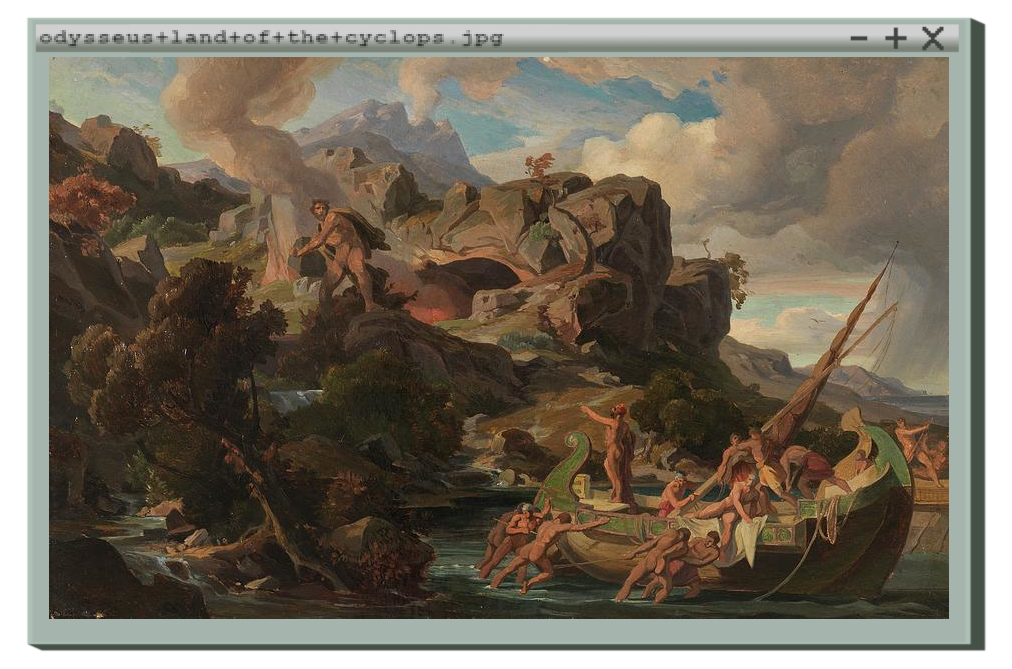
"Departure from the lands of the Cyclops," Friedrich Preller the Elder (1864)
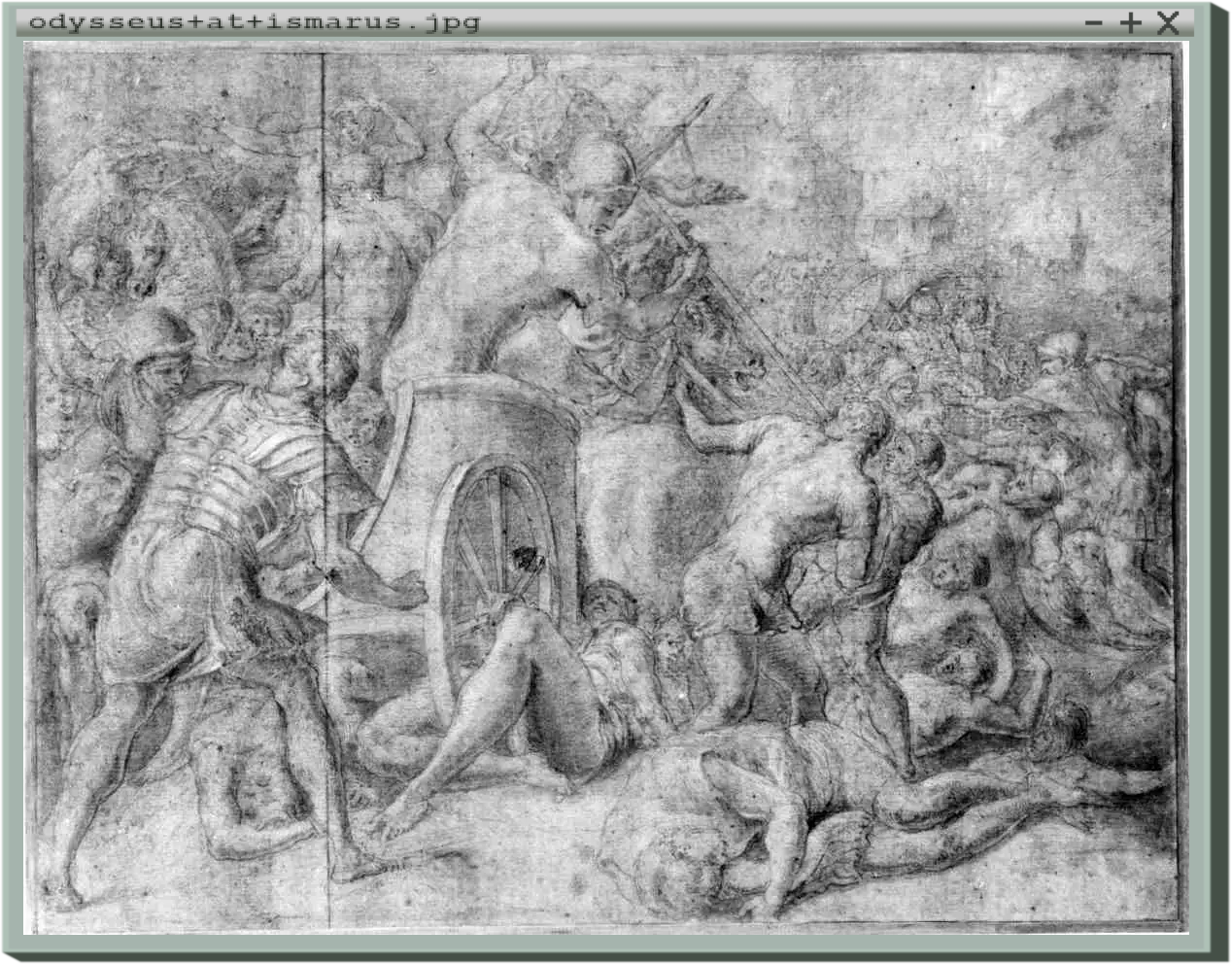
"Odysseus and His Companions Fighting the Cicones Before the City of Ismaros," by Francesco Primaticcio (1555–60)
Odysseus' story is filled with contradictions: he says the Cyclopes live isolated from each other and that they do not hold meetings, yet when Polyphemus calls out after he has been blinded, his neighbors come to his aid immediately; Polyphemus declares that the Cyclopes are not god-fearing, but later prays to his father, Poseidon, to let Odysseus back home after he has become a broken and lost everything—his ship and shipmates; and Odysseus asserts that he is a guest, owed a guest-gift, despite actually having barged into Polyphemus' home without an invitation. Polyphemus calls Odysseus and his men, "pirates, / sea wolves raiding at will, who risk their lives / to plunder other men" (9.286-288), which is proven by Odysseus himself at the beginning of the Book when he says, "The wind drove me out of Ilium on to Ismarus, / the Cicones' stronghold. There I sacked the city, / killed the men" (9.44-46). This challenges the idea of the civilized person that Odysseus presents himself as to the Phaeacians and proves he is in some ways even less civilized than the Cyclopes. Odysseus' claim that he is a guest, rather than an intruder, is an important part of the story he tells to the Phaeacians because it means the Cyclops, as host, has wronged him by violating Xenia, allowing him to warn his new hosts the consequences of not treating their guest right.
Reflection
I want to use this website to show my engagement with the content we're learning in Humanities Core creatively to better my understanding of the role worldbuilding plays in shaping our experiences. I think exploring the creativity that this digital space allows me to display has allowed to think more about worldbuilding in a way that I haven't done before. I look forward to exloring more material related to worldbuilding and expanding this website to reflect my thoughts and ideas about them.