Denote_
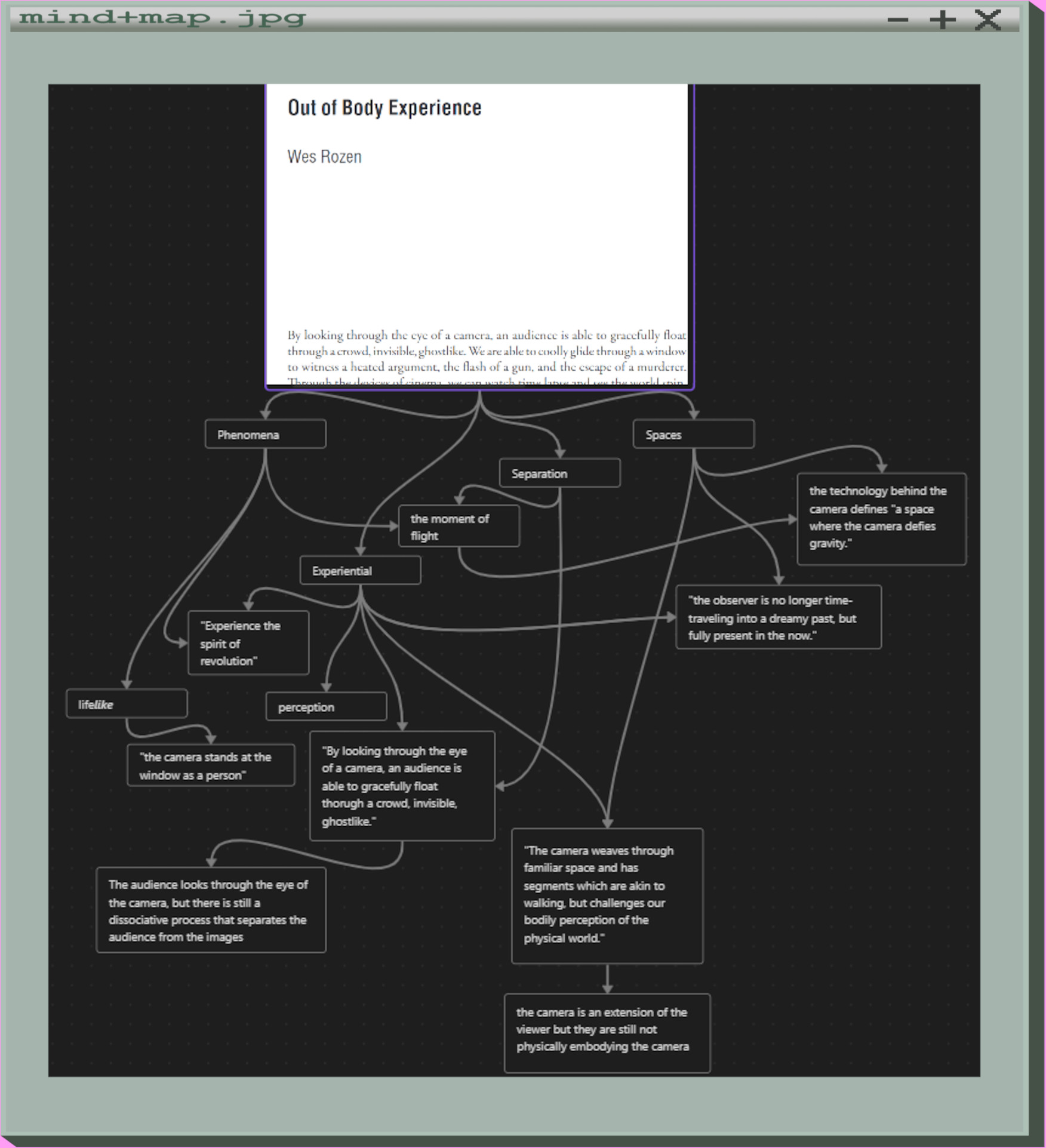
When I begin taking notes, I start by first writing down all the words that jump out to me in the tet or that I associate it with. I like to take notes by making a mind map where certain thoughts are attached to other thoughts, connected by ideas, phrases, or just what makes the most sense to me. THis free-assoicative method of note-taking allows me to remember what stuck out to me immediately and piece together what I remember from the text. The piece I'm annotating is "Out of Body Experience" by Wes Rozen.
Mind Map Example:
Phenomena -> lifelike -> "the camera stands at the window as a person"
Topic: Filmic Out-of-body Experiences
This article is exploring the replication of simulated out-of-body experience that films, in particular Soy Cuba, utilize to create an experiential sensation for the viewer. When watching a movie, the viewer is placed into the camera, physically putting the viewer in the present moment of what the camera is filming, while at the same time imbuing a degree of separation between the viewer and the viewed within the phenomena of the film and the experiencer. It examines how the perspective of the camera is lifelike but is able to break the limitations of what human mobility is able to accomplish to take on the spirited.
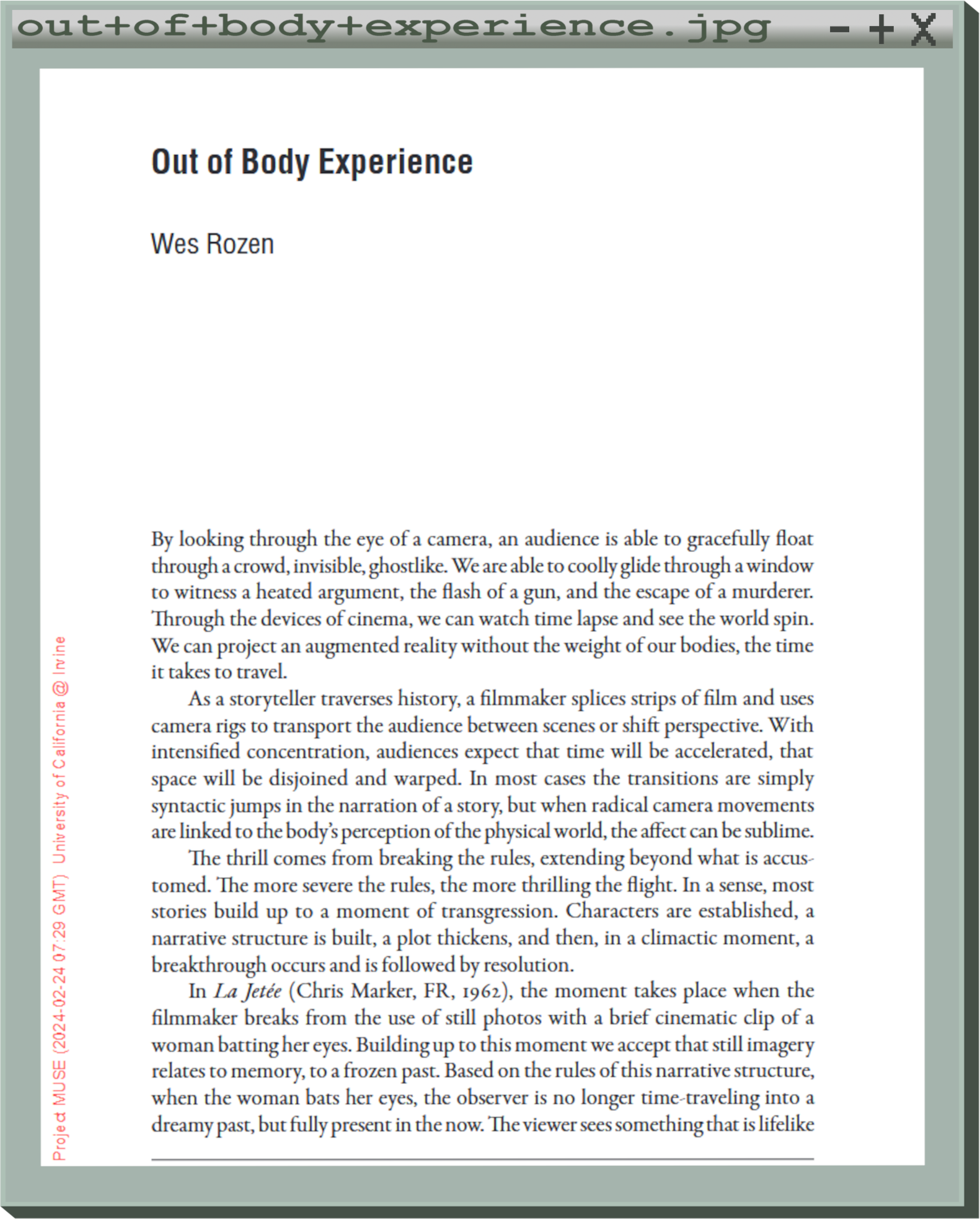
I think my annotation style is very unique in that it mirrors the forms of thoughts in my head, with all their abstractions. Sometimes, I disagree with the notes I take and will, in place of just deleting the note, add an addendum denoting my current thoughts as they contrast with any previous ones. I think letting them take the form of abstract thoughts help me reflect on the ideas being presented much better, as opposed to just remembering the literal words of the text.
Works Cited:
Rozen, Wes. "Out of Body Experience." Framework: The Journal of Cinema and Media, vol. 54 no. 1, 2013, p. 102-104. Project MUSE, https://doi.org/10.1353/frm.2013.0003.